
Growing blueberries in pots and bags with peat moss
Оваа статија е на англиски јазик.
Blueberries in pots and bags give growers control over the root zone, particularly where field soil is unsuitable. That control also makes irrigation and feeding decisions more important because the roots have only the volume of growing medium you provide.
Start with an unlimed, open-textured medium, then check what your water and fertiliser do to it over time. The right pot is not simply the largest one available. It must suit the plant, the irrigation system and the way excess water will leave.
Choose container volume for the plant and the irrigation system
A young blueberry can begin in a smaller pot and move into a larger container as its root system develops. In typical nursery practice, growers may start young plants in roughly 15 to 30 L and give established plants 40 to 60 L or more. These are planning ranges, not fixed requirements. Cultivar vigour, climate, production period and irrigation frequency all affect the useful volume.
Larger pots offer more room for roots and a bigger water reserve, but they can stay wet for too long if a small plant has not colonised the medium. Small pots dry quickly during warm weather and leave less margin when an irrigation cycle is missed. Check both extremes before setting a standard container size across a crop.
- Rigid pots. Choose a stable shape with ample drainage openings. A pot that stands clear of the ground makes it easier to see whether water is leaving freely.
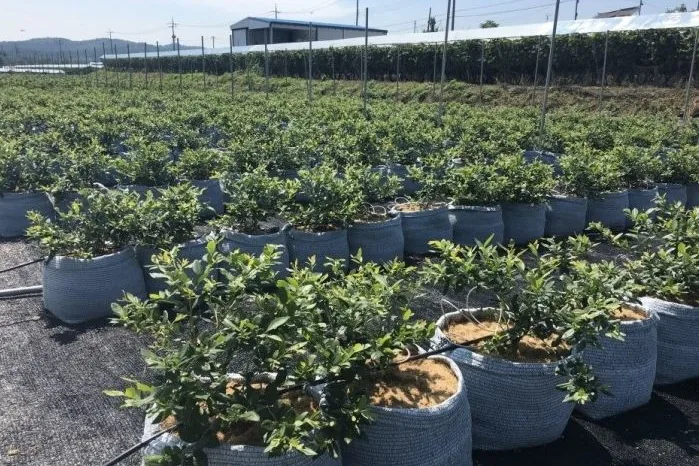
- Growing bags. Check the filled bag's shape, planting positions and drainage points. Support the bag so it does not sag into a wet channel or block its own outlets.
Whatever the container, allow enough space between plants for access to irrigation lines, inspection and picking. If you are comparing sizes, trial a few filled containers under your own watering schedule before ordering for the whole planting.
Drainage has to work throughout the crop
Blueberry roots need moisture and air at the same time. A medium can look dry on top while the base remains saturated, especially when a container stands on an impermeable surface. Inspect the lower part of a test pot or bag after irrigation rather than judging moisture by the surface alone.
Keep outlets open, and make sure drainage water can move away from the crop. If pots stand in runoff or bags lie in a low spot, improving the growing medium alone will not solve the problem. Raise containers or correct the surface drainage where necessary.
- Irrigation. Apply water in cycles that suit the container and weather, then check how evenly the medium wets. Adjust the schedule as the canopy and roots develop.
- Inspection. Check several positions in the block, including the wettest and driest. Compare container weight, moisture within the root zone and the amount of drainage after watering.
A coarse fraction can help preserve air spaces, but particle size is only one part of the drainage plan. Bag placement, pot openings and irrigation management still determine whether those spaces remain filled with air rather than water.

Build the root zone with unlimed white peat
Blueberries are acid-loving plants, so distinguish unlimed peat from a standard limed potting substrate before buying. SOLVIKA's unlimed white Sphagnum peat moss has a typical pH of 3.5 to 4.5 measured in water. It contains no added fertiliser, which means the feeding programme must be planned separately.
For planting two-year-old blueberries in pots and bags, a medium-coarse white peat screened to 0-40 mm is the usual starting point: SOLVIKA MIX 140LV and MIX 140W come in 250 L bags, and MIX 141 in 6000 L big bales. The finished root-zone conditions will still depend on filling, irrigation, drainage and subsequent management.
Moisten peat evenly before planting so dry pockets do not remain around the root ball. Fill consistently without pressing the medium hard into the container, and check the depth after the first irrigation. If you are blending a medium yourself, test the finished mix rather than assuming every ingredient will leave the original peat pH unchanged.
Keep a sample of the medium used at planting and record its test results. That gives you a useful starting point when you compare pH and electrical conductivity later in the crop.
Water alkalinity matters more than water pH alone
A low reading for irrigation-water pH does not necessarily mean the water will maintain an acidic substrate. Alkalinity, largely associated with bicarbonates, indicates how strongly the water can resist a change in pH. Repeated applications of high-alkalinity water can gradually raise root-zone pH even when the peat started acidic.
Have the actual irrigation source tested for alkalinity and other relevant salts before designing the watering and feeding programme. Repeat testing if the source changes or its composition varies through the season. Where treatment is needed, work from a water analysis and obtain qualified advice on equipment, dosing and safe handling.
Then measure conditions in the growing medium, not only at the water inlet. Samples taken at the same stage after irrigation and tested by a consistent method are easier to compare over time. Record the method alongside each result because readings from different extraction methods may not be directly comparable.

Feed blueberries without losing control of pH
Because unlimed peat contains no added fertiliser, blueberries in pots need a deliberate nutrient programme. Ammonium-based fertilisers are commonly considered for acid-loving crops because their use can help avoid the upward pH pressure associated with some other nitrogen programmes. They are not a substitute for checking the water, the medium and the crop.
Choose fertiliser and application rates from crop stage, water analysis, growing-medium tests and, where useful, leaf analysis. Excess ammonium or fertiliser salts can damage roots, particularly in a small container. Split feeding to match plant demand and irrigation practice rather than applying a heavy dose to correct a weak-looking crop.
- Before feeding. Confirm what nutrients and alkalinity the irrigation water already supplies. Set a baseline for root-zone pH and electrical conductivity.
- During production. Watch new growth and test the medium regularly. If readings drift, investigate water, fertiliser and drainage together before changing the recipe.
Keep pH low by measuring change over the years
Peat gives a blueberry planting an acidic start, not a permanent exemption from pH management. Water alkalinity, fertiliser choice and any materials added at potting or top-dressing can change the root zone over successive seasons. Record pH trends for each block so a gradual rise is visible before plants show clear symptoms.
Many growers aim to maintain an acidic root zone around pH 4.5 to 5.5 for blueberries, but the useful target and test method should be agreed for the particular crop and production system. Test representative containers, including plants at the ends of irrigation runs. If results differ widely, solve the variation rather than making one adjustment for every plant.
At each potting-on, check the pH and composition of both the old root ball and the fresh medium. Avoid assuming that an acidic new fill will immediately correct an older, higher-pH root ball. Where a change to water treatment or feeding is needed, make it from measured results and check the response.
Frequently asked questions
Can I use ordinary potting compost for blueberries in pots?
Check its pH and ingredients first. Blueberries need an acidic root zone, while many general potting substrates are limed for other crops. An unlimed white peat base lets you plan the blueberry feeding programme separately.
Is unlimed peat enough to keep a pot acidic for years?
No. Its initial acidity can change with irrigation water, fertiliser and materials added later. Test the root zone consistently and use the results to guide water and feeding decisions.
Should I check the pH of my irrigation water?
Yes, but ask for alkalinity as well. Water pH alone does not show how strongly repeated irrigation may affect the growing medium. Test the actual source used for the crop.
Do blueberries in peat need fertiliser?
Yes, when they are grown in unlimed peat with no added fertiliser. An ammonium-based programme may suit an acid-loving crop, but the formulation and rate should follow water, medium and crop tests. Monitor root-zone pH and electrical conductivity as you feed.
For a recommendation or a delivered price, send us the plant age, container or bag volume, expected quantity, irrigation-water analysis, packaging preference and delivery destination. Include any current growing-medium specification you want us to compare.


